Universal land mobile antenna for mobile broadband communication via Ka satellites
Land mobile antenna
Reliable Data and Voice Connections for Emergency Vehicles and Mobile Platforms
Project Idea & Initial Situation
The goal of the project was to develop a universal land-mobile terminal for mobile broadband communication via Ka-band satellites. The focus was on a VSAT antenna solution specifically designed for vehicle-mounted “on-the-move” operation. The system was required to be compact, robust, and high-performing in order to ensure stable data and voice connections even while the vehicle is in motion.
Special emphasis was placed on a low center of gravity, compact design, and the ability to withstand high accelerations and vibrations encountered during mobile operation. The planar design was intended to provide a flat antenna profile while maintaining high gain, and to support both geostationary satellites as well as future LEO and MEO satellite constellations.
Development Steps
Antenna Concept & Manufacturing
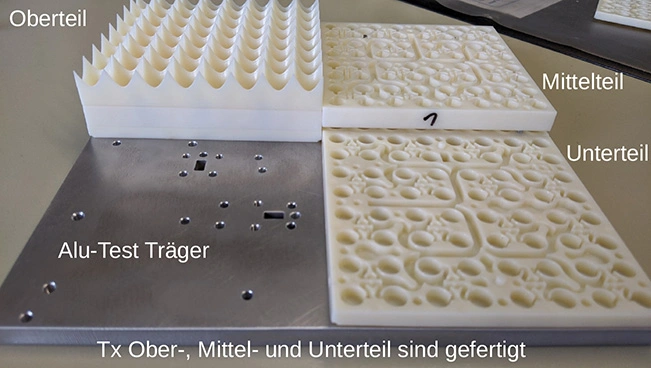
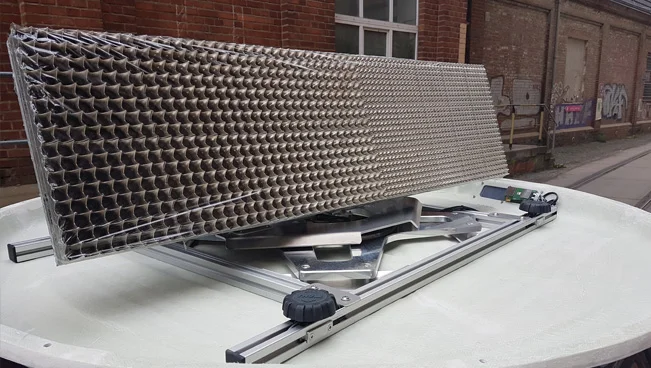
Development of a modular planar antenna aperture consisting of 15 Tx and 8 Rx modules (dimensions: 110 × 30 cm), manufactured using injection molding and galvanic metallization. The active Rx aperture enables electronic beamforming and beam steering via adjustable phase shifting.Mechanics & Integration
Optimization of the mechanical design to achieve minimal height and weight, including vibration-optimized subassemblies and dedicated mounting points. Development of a robust elevation and azimuth drive system using planetary gears, timing belt drives, and stepper motors.Electronics & Control
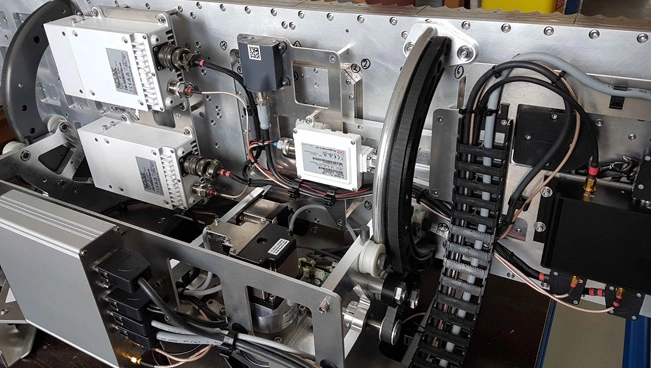
Integration of receive and transmit electronics (BUC, LNB), development of a waveguide combiner and hybrid coupler to realize circular polarization. Implementation of a 3D inertial sensor module with an extended Kalman filter for precise tracking and target angle calculation directly within the sensor.System Testing & Optimization
Execution of vibration, shock, and environmental tests (up to 55 °C), integration of a ventilation system, and extension of the electronics with diagnostic and monitoring interfaces. Software development for automated temperature calibration and adaptation of control algorithms to mobile operating conditions.
Results & Demonstrators
The project resulted in a fully functional demonstrator capable of providing stable Ka-band broadband communication during mobile operation. The compact design, flat antenna profile, and robust mechanics were successfully validated in laboratory and field tests.
The system supports both electronic and mechanical tracking, circular polarization, and automated diagnostic functions. Key technical parameters include:
Frequency range: Rx 19.2–20.2 GHz, Tx 29.0–30.0 GHz (Ka-band)
Aperture: Planar, modular, 110 × 30 cm, consisting of 15 Tx and 8 Rx modules
Antenna gain: Sufficient for GEO, LEO, and MEO communication
Tracking: Electronic (beamforming, polarization) and mechanical (azimuth/elevation)
Mechanics: Vibration- and shock-optimized, low center of gravity, compact design
Electronics: Integrated 3D sensor module, over-the-air updates, extensive diagnostic capabilities
Field and laboratory tests confirmed the reliability and performance of the system under real operational conditions.
Technological Basis
The land-mobile terminal is based on a modular, planar antenna aperture made of metallized plastic segments produced via injection molding. The active Rx aperture enables electronic beamforming, while the Tx aperture is fed via a hybrid coupler.
Tracking is performed both electronically (beam steering and polarization) and mechanically (azimuth and elevation). A 3D inertial sensor module with an extended Kalman filter provides precise position determination and target angle calculation.
The control electronics are designed to withstand high mechanical and environmental loads and support over-the-air updates as well as comprehensive diagnostic and monitoring functions. The system is designed for flexible integration into various vehicle types and mobile platforms.
A specially developed radome made of glass-fiber-reinforced plastic reliably protects the antenna aperture and electronics from environmental influences and mechanical stress, contributing to the overall robustness of the system.
Cooperation
The land-mobile antenna was developed in cooperation with IMST and with support from the German Aerospace Center (DLR). EPAK was responsible for system integration, development of the control electronics, and overall system architecture, while IMST handled the development of the beamforming drivers and phase control.