2-Way Satellite Flat Antenna in the Ku-Band for Use on Waterborne Vessels
Flat panel in the Ku-band for use on waterborne vessels
Compact two-way satellite communication with flat antenna for portable and maritime applications
Project Idea & Initial Situation
Conventional satellite systems are often large, expensive, and difficult to install. The goal of the Sat-IP project was to develop a compact, versatile two-way satellite communication system with an integrated flat antenna in the Ku-band.In contrast to traditional parabolic antennas, the system was designed to offer reduced size, easier installation, and lower cost. The solution is primarily aimed at maritime and portable applications, but it can also be adapted for land-mobile use.
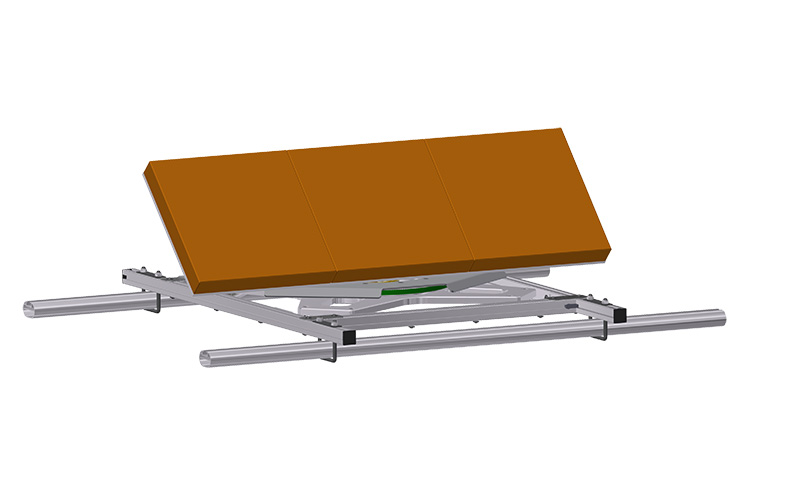
The antenna was intended to be unobtrusive, robust, and space-saving, featuring a modular design. Azimuth control of the antenna was performed mechanically using the EPAK platform, while electronic beam tracking in elevation was implemented using reflection phase shifters developed by TU Berlin.
Development Steps
- Material and Component Selection Selection of suitable substrates for the antenna elements, balancing cost, RF suitability, and mechanical durability. Glass-fiber-reinforced plastics were used for the housing to ensure mechanical stability and good high-frequency performance.
- Antenna Concept and Simulation Development and simulation of a modular patch-array antenna concept with electronic beam steering, enabling high bandwidth and gain. Individual patch elements were optimized for bandwidth, gain, and isolation and then combined into larger groups.
- Integration of Receive and Transmit Modules Construction of a receive-transmit module with block-down and block-up converters, and integration of a two-way satellite modem (e.g., iDirect X7) with standardized interfaces for antenna control.
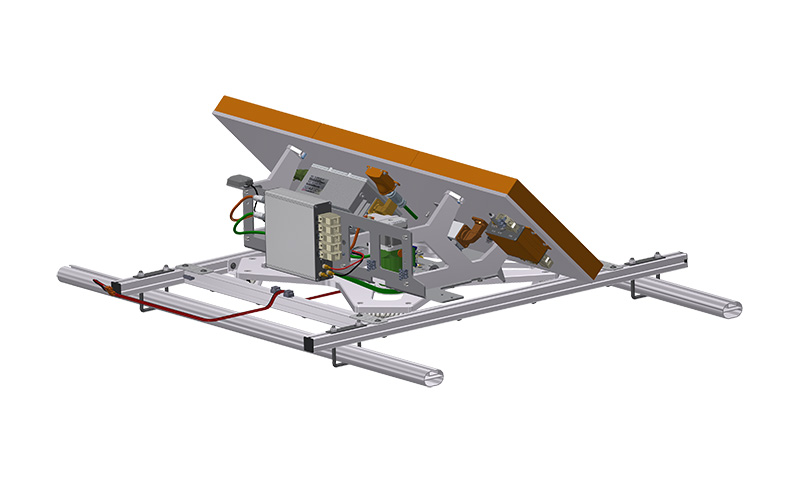
- Mechanical Positioner Development of a precise and robust positioning system for azimuth alignment that operates reliably even under motion (e.g., on ships or vehicles). Elevation control is performed electronically.
- Prototype Construction and Testing Assembly of a functional prototype, integration of all components, and execution of laboratory and field tests to validate system performance. Control algorithms were optimized for tracking and signal quality and adapted to new market requirements (e.g., LEO constellations).
- Redesign and Further Development Following initial tests, mechanical components such as the baseplate were revised to further increase stiffness and stability. The modular design enables flexible adaptation to various applications and future requirements.
Results & Demonstrators
A fully functional demonstrator was realized in the project, enabling internet access, VoIP, and data communication via satellite. The compact form factor (e.g., 40 × 30 cm, < 6 kg), easy integration into various platforms, and robust design were confirmed in field tests. The control electronics allow precise electronic beamforming and tracking even while in motion. Key technical specifications include:- Frequency range (Ku-band): Rx 10.7–12.75 GHz, Tx 13.75–14.5 GHz
- Modular patch-array design: approx. 30 dBi gain per module
- Electronic beam steering in elevation, mechanical alignment in azimuth
- Dual polarization, temperature range –20…60 °C
- Control range: Azimuth 360°, Elevation 60°
- Max. transmit power: 41 dBW
Field tests demonstrated that the system operates reliably on maritime platforms as well as on vehicles and can be flexibly adapted to various deployment scenarios.
Technological Basis
The system is based on a flat, electronically steerable multi-beam antenna in the Ku-band with a modular patch-array structure. The antenna is designed for both stationary and mobile use. The control electronics enable precise tracking and beamforming even under motion.
The receive-transmit module integrates block-down and block-up converters as well as a satcom modem with an OpenAMIP interface for standardized connection to various modems. The mechanical platform enables robust and precise antenna alignment, supported by a stepper motor and a specialized bearing system designed for high loads and environmental influences.
The housing (radome) is made of glass-fiber-reinforced plastic and reliably protects the electronics from weather conditions.
Cooperation
Development was carried out in close collaboration with TU Berlin, which was responsible for electronic beam tracking and the evaluation of the antenna aperture. EPAK GmbH developed the mechanical platform, integrated the control electronics, and handled the overall system design. Industry partners such as Becker & Müller supported the selection and processing of suitable materials for industrial production. Collaboration with constellation operators and suppliers enabled adaptation to new market requirements, particularly regarding LEO satellite constellations.
The modular design allows for future upgrades and transfer into industrial manufacturing processes.