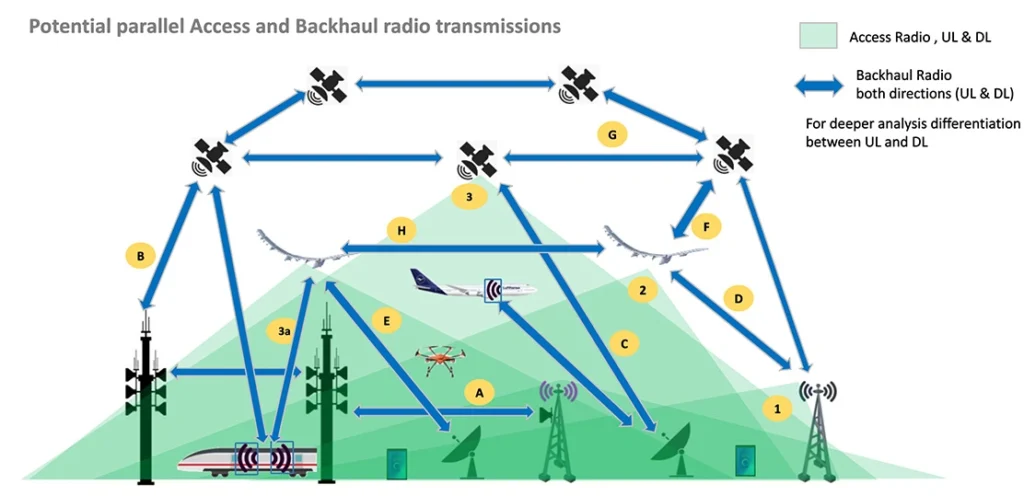
Unified 3D communication network
A Project for Testing Pioneering Communication Technologies in Real-World Scenarios
Project Idea & Initial Situation
With 6G, sub-millisecond latencies, extremely high data rates, and seamless integration of terrestrial and satellite-based communication are expected to become possible. EPAK aims to evaluate these technologies under realistic conditions through pilot projects.
Development Steps
Design and simulation of new waveforms and beamforming techniques
Development of RF front ends using waveguide components and adaptive antennas
Integration of drone tracking and 3D communication networks
BLDC-controlled ground station units for precise alignment
Field tests to verify range, latency, and energy efficiency
Results & Demonstrators
The project produced fully functional demonstrators showcasing the use of 6G in various scenarios. These include real-time control of autonomous systems, immersive communication applications, and new security solutions. The developed RF front ends and antenna systems were successfully tested and validated.
Technological Basis
The demonstrators integrated RF front ends, adaptive beamforming algorithms, and BLDC-controlled ground station units. Waveguide components were additionally used for signal routing. Simulations and field tests provided realistic insights into the performance of 6G technologies in real-world scenarios.
Cooperation
Collaboration with more than 20 renowned partners from industry and research, including Deutsche Telekom AG, Rohde & Schwarz, IMST GmbH, TU Kaiserslautern, and the University of Bremen.